Project breakdown · Early Development
Sentinel
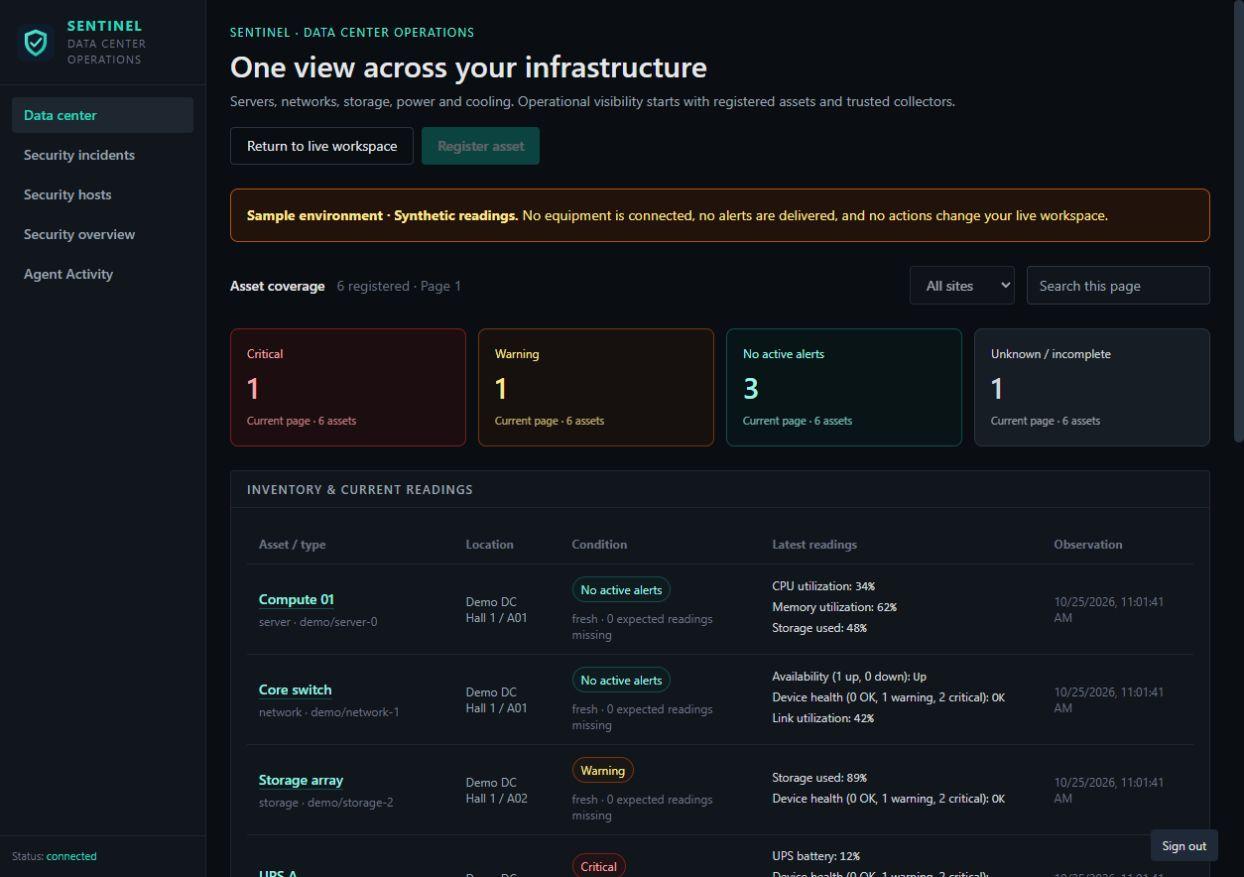
An early-access preview (0.5) for mixed on-premises data centers: operators register equipment by site, room, and rack, connect read-only host or targeted Redfish collectors, and follow telemetry history, threshold alerts, and coverage gaps in one workspace. Security investigations and workstation tools remain available separately.
Why I built it
The product started as a single-PC monitor; the work outgrew that shape, so the primary surface became a mixed on-premises data-center control plane.
What works today
What exists today: site, room, and rack inventory, atomic telemetry batches, confirmed threshold alerts with acknowledgement, coverage-gap visibility, a read-only host collector, targeted Redfish snapshots, and a Windows 0.5 early-access preview. SNMPv3, hypervisor and BMS connectors, maintenance workflows, and notification delivery remain planned.
What I wanted to learn
- Normalize facility telemetry behind one authenticated API.
- Keep collection read-only and explicit — no discovery, no device actions.
- Expose coverage gaps and uncertainty instead of certifying health from missing data.
How it works
- Register inventory explicitly by site, room, and rack with expected intervals and thresholds.
- Accept atomic telemetry batches from authenticated service collectors only.
- Confirm threshold transitions only on repeated readings; missing or stale data never clears an alert.
Technical structure
A FastAPI control plane owns org-scoped inventory, telemetry ingestion, alert state, and audit transitions behind role-based auth: admin registration, service-key reporting, dashboard reads. Read-only collectors run inside the site network — a host collector for CPU, RAM, and system-volume usage and a targeted Redfish collector for system, chassis, and sensor snapshots over verified TLS — and push normalized readings to the API. A React and TypeScript dashboard renders inventory, history, alerts, and coverage gaps. The Windows console still runs its owned API on loopback for local preview.
Testing
- API tests cover tenant boundaries, atomic batches, duplicate and out-of-order handling, and nonfinite-input rejection.
- Collector tests cover TLS boundaries and identical-observation retries.
- CI runs API, web, windows-monitor, and semgrep checks on every change.
Deployment
The Windows 0.5 early-access preview is distributed from the public landing page. Remote collectors need a separately deployed reachable HTTPS control plane, and polling physical equipment runs inside the site, not in a serverless request.
Technical decisions
- Keep collectors read-only: no subnet discovery, no followed links, no device actions.
- Treat unknown, stale, and failed readings as not healthy — never as proof of health.
- Keep the preview free with no checkout or paid-plan promise while the product is validated with operator feedback.
Challenges
Combine inconsistent facility telemetry without hiding different meanings, update schedules, or failure modes — and without presenting the preview as a complete DCIM or production monitoring platform.
What I learned
This project is teaching me how to scope a product honestly: what is implemented, what is planned, and what the preview explicitly does not claim — and to keep collection read-only when the tool touches other people's equipment.
What I'd improve next
Validate the preview with operator feedback, then expand connector coverage before making any production claims.